You pull the Pale Grin mask down over your face, ease open a screen door somewhere in Happyhills, and listen for footsteps that aren’t yours before you decide which room to enter next.
Playing Both the Pale Grin and Detective Bryan Pawalski
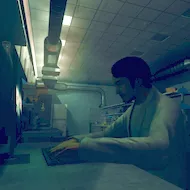
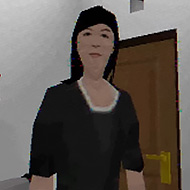
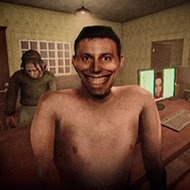
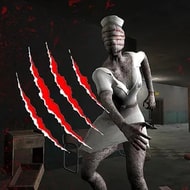
The Happyhills Homicide splits its runtime between two perspectives that never quite trust each other. As the Pale Grin, a clown-masked killer, you sneak through homes and public spaces in Happyhills stalking unsuspecting victims, relying on stealth to line up a kill without drawing attention from anyone nearby. As Detective Bryan Pawalski, you walk into the mess left behind afterward, interviewing witnesses and piecing together what actually happened from clues the killer left scattered around each scene.
The dual structure means the game never lets you settle into one rhythm for long.
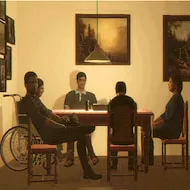
Interrogation sections have you watching for inconsistencies in what suspects say, cross-referencing statements against physical evidence, which turns The Happyhills Homicide into something closer to a detective puzzle game every time it hands control back to Pawalski.
Why John Wade Picked These Particular Victims
The Pale Grin’s real identity is John Wade, a former janitor at Westpine High, and nearly every victim across the game’s levels was one of his old bullies from that period, several of whom had nearly killed him during a prank that went wrong. That backstory reframes the killing spree from random slasher violence into something closer to a checklist being worked through methodically, which changes how you approach each level once you realize the victims aren’t interchangeable strangers.
Madison is the one clear exception to that pattern. She was the only person who ever treated John Wade with kindness, and her death happens almost by accident, in a way the game visibly treats differently from every other kill, with the Pale Grin showing something closer to remorse rather than satisfaction afterward.
That single scene is the one moment most players bring up first when discussing the game, since it’s the clearest crack in an otherwise methodical killer’s motivation.
The Happyhills Homicide’s Twenty Levels of Escalating Risk
- Sneaking inside homes without triggering line-of-sight detection from bystanders
- Acquiring a specific murder weapon before a kill sequence can even begin
- Waiting out patrol patterns until a target is isolated long enough to strike
- Escaping a scene cleanly enough that Pawalski’s later investigation finds fewer usable clues
Across twenty uniquely designed levels, the stealth demands shift from simple patrol-avoidance early on to more layered scenarios where multiple witnesses move independently and a single mistake can cascade into a failed level. Later levels expect you to already understand how sightlines and sound work from the earlier ones, so players who rush the tutorial-adjacent opening levels tend to struggle once the town’s layouts get denser.
Detective-focused players who enjoy the interrogation puzzles more than the stealth sequences often replay Pawalski’s chapters specifically to see how many clues they can gather without missing a single inconsistency, treating those levels almost like a separate game layered on top of the slasher half.
Madison and the One Kill the Game Regrets
Where every other victim’s death plays out with a kind of grim satisfaction built into the pacing, Madison’s fall down the stairs is staged and scored completely differently, and the game slows down around it rather than rushing to the next scene. Players who’ve gone through all twenty levels consistently point to this as the moment The Happyhills Homicide stops being just a gruesome slasher game and starts asking you to actually feel something about John Wade as a person rather than a masked threat.
It’s also the scene most responsible for the game’s ongoing community debate about whether the story earns sympathy for its killer or undercuts its own horror by trying.
Stealth purists tend to shrug off that debate entirely and focus instead on optimizing kill routes level by level, while narrative-focused players treat Madison’s death as the actual thesis of the whole game.
- Who is the killer in The Happyhills Homicide? The Pale Grin is revealed to be John Wade, a former janitor at Westpine High who is working through a list of old bullies as his victims, with nearly every kill in the game tied directly back to that history.
- Do choices matter in The Happyhills Homicide? Yes — beyond stealth execution, the game includes moments where you decide how a scene plays out, and Madison’s death in particular is handled with noticeably different pacing and tone compared to every other kill, reflecting John Wade’s own reaction to her.
- How many levels does The Happyhills Homicide have? The game contains twenty distinct levels, alternating between the Pale Grin’s stealth-driven kill sequences and Detective Bryan Pawalski’s interrogation and clue-gathering chapters investigating the aftermath.
The Happyhills Homicide earns its tension by making you complicit as the Pale Grin and then handing you the magnifying glass as Bryan Pawalski, and it’s Madison’s death, more than any of John Wade’s twenty carefully planned kills, that players still bring up long after finishing the town’s last case file.