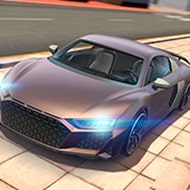
Extreme Car Driving Simulator looks like a straightforward arcade racer from its store thumbnail, but it plays like a physics sandbox that punishes anyone who mashes the throttle without reading the road first.
| Genre |
Open-world driving |
| Platform |
Mobile and browser |
| Available since |
2014 |
| Zones |
City asphalt, offroad, airport runway |
| Modes |
Open world, checkpoint, traffic, parking |
There’s no story campaign here and no forced objective sitting between you and the ignition. The game drops you into an open city with a car, working brakes, and a set of physics that reward smooth inputs far more than aggressive ones.
City Asphalt, Offroad Zone, and the Airport Runway
The map splits into three distinct spaces, each rewarding a different driving style. The city asphalt is where most drift practice happens, tight enough that corners come up fast and traffic gives you something to weave around. The offroad zone strips away the road entirely, trading tarmac grip for looser terrain that punishes drivers who try to drift the way they would in the city.
The airport runway is the outlier — long, flat, and empty enough that it exists mainly for one purpose: finding out what a car’s actual top speed looks like without a corner or pedestrian in sight. Players chasing a specific supercar’s max speed almost always end up here rather than on city streets.
Casual players tend to stick to the city because it’s visually the most eventful of the three, while speed-focused players gravitate toward the runway specifically because nothing gets in the way of a clean top-speed run.
Drifting and Torque Control Through the Handbrake
Drifting in the game isn’t a scripted animation triggered by a button — it comes from actual weight transfer, throttle timing, and handbrake input working together. Braking mid-turn breaks traction and lets torque carry the rear end around, and getting that timing wrong usually ends in a spin rather than a clean drift line.
New players tend to overcorrect once a drift starts, snapping the wheel back too hard and sending the car into a fishtail instead of a controlled slide. It takes a handful of failed attempts before the relationship between brake pressure and steering input starts to feel predictable rather than random.
Torque control: managing how much rotational force reaches the wheels mid-drift, which is what separates a held slide through a corner from a car that simply spins out.
ABS, Traction Control, and ESP as Optional Crutches
All three driving aids can be toggled independently, and each one changes the feel of a car noticeably. ABS keeps wheels from locking under hard braking, Traction Control limits wheelspin on throttle, and ESP intervenes when the car starts sliding beyond a safe angle. Turning all three off is the closest the game gets to a genuine skill test, since every drift, brake, and correction is entirely on the player from that point on.
Experienced drifters usually run with ESP and TC disabled but keep ABS on, since it’s the one aid that doesn’t fight against intentional sliding the way the other two do.
Trial, Radar, and Destruction Challenges
Scattered across the open world are entry points into three mini-game types. Trial challenges test precision driving through tight courses, radar events clock your speed through a set stretch of road, and destruction challenges reward players for causing as much crash damage as possible within a time limit. None of these are mandatory, but they’re the main source of structured objectives in a game that otherwise leaves you to set your own goals.
Building a Car Collection in the Garage
The garage is where unlocked vehicles live, spanning SUVs, classic cars, and dedicated racing builds, each with noticeably different handling rather than shared stats behind different paint. Unlocking new cars ties directly into completing objectives scattered through the open world, so players chasing a specific supercar usually end up working through several challenge types along the way rather than one.
Traffic Mode Versus Open World Freedom
Switching into traffic mode fills the streets with AI vehicles that force real navigation decisions — sudden lane changes, braking for intersections, actually reading the road instead of treating it as empty space. Open world mode strips most of that away, letting players drift, jump, and crash without dodging other cars or worrying about consequences. Most players bounce between both depending on whether they want a relaxed sandbox session or something closer to a real driving test.
Customization, Tuning, and Photo Mode
Beyond paint jobs and decals, tuning options extend to tires and performance-oriented adjustments that change how a car actually handles rather than just how it looks. Photo Mode exists purely for capturing a customized build mid-drift or parked at a scenic point in the offroad zone, and it’s become a minor community habit — players sharing screenshots of unusual liveries or dramatic crash angles.
Realistic Damage and Repairing a Wrecked Car
Crashes leave visible, lasting damage rather than a cosmetic scratch that disappears on its own, and repairing a car afterward is part of the loop rather than an afterthought. Community discussion around the game often centers on this exact system — some players love how consequential a bad landing off the airport runway feels, while others find the repair requirement tedious when they’d rather just keep driving. Turning off traffic is done through the mode selector rather than a settings toggle, and it’s the fastest way to get back to pure open-world driving without any AI vehicles in the way.
Extreme Car Driving Simulator never pretends to be more than what it is — a sandbox built around the airport runway’s straight-line speed, the city asphalt’s drift lines, and a garage slowly filling up with cars earned one challenge at a time.