What actually happens if you release the launch arm half a second too early in Rocket Pult? You lose distance, and not by a little — timing the release is the single biggest factor separating a mediocre launch from a run worth screenshotting.
| Genre |
Physics-based launch and arcade |
| Core Mechanic |
Build momentum, launch, adjust mid-flight |
| Objective |
Maximize distance and land cleanly |
| Key Tool |
Slow time, for precise mid-air corrections |
Building Momentum on the Catapult Before You Even Launch
Every round in Rocket Pult starts the same way — your rocket sitting on the catapult arm, waiting for you to build enough swing to make the launch worthwhile. This is where most new players get it wrong. Holding the thrust button down feels intuitive, but the arm actually responds better to short, timed taps that build a rhythm rather than one continuous push.
Once you’ve got a feel for the swing, releasing at the peak of the forward arc is what sends the rocket out at a useful angle instead of straight into the dirt a few meters away. Too early and the launch angle is too shallow; too late and you lose most of your built-up momentum before the rocket ever leaves the arm. Players newer to the game often obsess over speed without paying attention to that release window, which matters just as much.
Casual players tend to mash the thrust button and hope for the best, while players chasing leaderboard distances treat the swing-up as its own small skill to master before they even think about what happens in the air.
Mid-Flight Control and When Slow Time Actually Helps
Once the rocket leaves the catapult, Rocket Pult hands you a second layer of control most launch games don’t bother with — you can rotate the rocket mid-air and use slow time to make fine adjustments to its trajectory. This is what separates the game from a straightforward “aim and release” formula.
Slow time isn’t meant to be held constantly. Burning it the moment you launch usually wastes the resource before you actually need it, typically near the top of the arc where small corrections matter most. Saving it for that window, when the rocket’s path is about to tip from rising to falling, gives you the cleanest shot at threading past obstacles or lining up with a floating target.
By the time you’re several launches into a session, the difference between a decent distance and a genuinely long one usually comes down to whether you saved slow time for the moment it actually mattered.
Reading Terrain, Wind, and Floating Bonus Targets
Every launch area throws a different mix of terrain and obstacles at you — skyscraper silhouettes, airborne platforms, and open stretches with nothing but wind resistance to account for. Floating objects sitting on the water below are worth watching for too, since clipping them mid-flight adds to your score on top of raw distance.
Wind changes how aggressively you need to correct with slow time. A run that would land perfectly on a calm stretch can drift wide once wind resistance is added to the equation, and players who ignore it tend to plateau at the same distance for a long time before realizing why.
- Skyscraper zones — reward height over raw distance
- Open stretches — where wind resistance matters most
- Water sections — floating targets add bonus points
Landing Technique and What Separates Good Runs From Great Ones
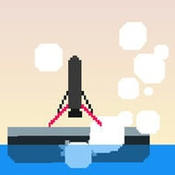
Distance gets you noticed, but landing cleanly is its own skill entirely. Turning the rocket to face upward and braking with short thruster bursts before deploying landing legs is the difference between a controlled finish and a rocket that tumbles the last few meters and loses whatever bonus a clean touchdown would’ve added.
Some players in the community have found that repeatedly bumping into the higher-multiplier platforms before finally landing stacks bonus points in a way the game clearly wasn’t built around, and it’s a genuinely divisive topic — some treat it as a clever use of the system, others see it as an exploit that undercuts the point of mastering an actual landing.
- Long-tail question: How do you control a rocket after launch in Rocket Pult? Rotate mid-air using the flight controls and lean on slow time near the peak of the arc, where small adjustments have the biggest effect on where the rocket eventually comes down.
- Long-tail question: What does slow time actually do in Rocket Pult? It slows the entire flight down temporarily, giving you a wider window to rotate and correct the rocket’s trajectory before gravity takes back over.
- Long-tail question: How do you land safely in Rocket Pult? Angle the rocket upward, brake with short bursts instead of one long thrust, and deploy the landing legs just before touchdown to avoid tipping over on impact.
Rocket Pult rewards exactly the kind of patience its own physics punish you for ignoring — swing, release, adjust, land. Once landing legs stop feeling like an afterthought and start feeling like the actual goal of a run, Rocket Pult stops being a game about distance and starts being one about control.