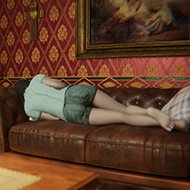
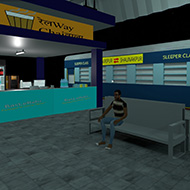
You press yourself flat against a chain-link fence, your body still tacky with the rust-brown paint you slapped on ten seconds ago, and a Seeker’s flashlight sweeps right past you without slowing down. That single moment of held breath is what Meccha Chameleon is built around, and it explains why a $6 hide-and-seek game turned into one of the biggest indie hits of the year.
| Genre |
Multiplayer hide-and-seek party game |
| Platform |
Windows (PC) |
| Recommended Players |
2 to 10 per lobby |
| Core Mechanic |
Painting your body to match the environment |
Hider Tactics That Make Meccha Chameleon Rounds Unpredictable
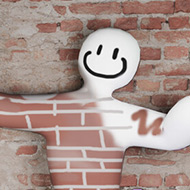
Every Hider starts a round as a plain white figure standing in the open, which is the opposite of subtle. What turns that blank canvas into a threat is the painting tool, a simple brush-and-eyedropper system that lets you sample colors straight from nearby surfaces. New players almost always paint too fast and too flat, covering their whole body in one dull shade instead of matching the texture and shadow of what they’re hiding against. A convincing disguise usually needs at least two tones, sometimes three, because a single color reads as a person-shaped blob the second a Seeker’s flashlight lingers.
Positioning matters just as much as color accuracy. A near-perfect paint job in the wrong spot still gets spotted immediately, while a rougher disguise tucked into a shadowed corner or an awkward pose can survive an entire round. Players who take the game seriously talk about reading a stage the way you’d read a room before a magic trick: what’s already busy, what’s empty, and where a Seeker’s eyes are most likely to skip over. This is the part of the game that rewards patient players far more than reflex-driven ones.
By the time a lobby reaches its second or third round on the same stage, the disguises get noticeably more elaborate, since everyone has already seen the obvious spots get picked apart. That escalation is part of what keeps sessions from going stale even when the map hasn’t changed at all.
What Seekers Actually Watch For
Playing Seeker flips the entire mental model. Instead of hiding, you’re scanning for the small inconsistencies that give a disguise away: a slightly wrong shade of green, an outline that doesn’t quite match the object behind it, or a Hider who freezes a half-second too late after you turn a corner. Competitive Seekers develop habits fast, sweeping rooms in patterns rather than wandering randomly, and listening for the tiny sound cues the game gives off when someone shifts position.
- Color accuracy against the immediate background
- Silhouette shape versus the object being mimicked
- Micro-movement while a Seeker is nearby
- Odd placement, like a “chair” standing in an open hallway
Streamers who host public lobbies tend to favor the Seeker role because it produces the funniest reactions on camera, which is a big reason Meccha Chameleon spread so quickly once viewer-participation matches became common.
Community Habits Around Meccha Chameleon Lobbies
One of the more divisive topics in the community right now is cheating. Some players have been caught using image-scanning tools that auto-paint a model to match its surroundings almost instantly, which strips out the entire skill element the game is built around. There’s also an ongoing debate about the in-game shotgun, which some players feel clashes with the otherwise silly, kid-friendly tone of painting yourself into a wall.
None of that has slowed the game’s growth much. It crossed 15 million copies sold within weeks of launch, an unusually fast pace for a two-person indie project, and public lobbies stay full well past midnight in most regions.
How do you fix a bad camo job quickly in Meccha Chameleon?
Use the eyedropper to resample the nearest surface rather than eyeballing a color from memory, then adjust your pose to break up your outline instead of standing rigid against a flat wall.
Why do people cheat in Meccha Chameleon?
Some players use external image-scanning tools that automatically match a Hider’s paint to the surrounding texture, removing the manual guesswork the painting system is designed around.
Can you play Meccha Chameleon with just two people?
Yes, lobbies support as few as two players, though most of the community agrees the game gets more chaotic and more fun once a lobby reaches six or more.
Whether you’re the one sweating behind a fence post or the one squinting at a suspiciously still radiator, Meccha Chameleon keeps working because neither role ever fully solves the other. Learn the shotgun’s range, learn to fake a shadow, and the next round will still find a way to surprise you.