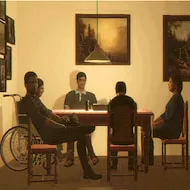
Granny Escape Together puts a second player inside the same locked house and the same five-day countdown that built the original Granny formula.
Two Players, One Five-Day Clock in Granny Escape Together
The core structure hasn’t changed: you wake up locked inside Granny’s house with no memory of how you got there, and you have five in-game days to find a way out before Granny or Grandpa catches you enough times to end the run. What Granny Escape Together changes is who’s doing the searching. Instead of one player quietly memorizing item spawns and escape routes alone, two players split the house between them, which sounds like it should make the whole thing easier and, in practice, often makes it more chaotic instead. Coordinating footsteps, item pickups, and hiding spots between two people generates more noise opportunities than solo play ever did, and Granny’s hearing doesn’t get any more forgiving just because there are two of you.
Where a solo run rewards patience and total silence, co-op rewards communication. A team that talks through a headset or shared chat about where the Crossbow spawned or which door is already unlocked will consistently outperform a team that splits up and explores independently without checking in.
Splitting the House: Who Grabs the Crossbow, Who Grabs the Key
Efficient co-op runs tend to divide the house by floor or by task rather than by random wandering. One player typically handles item collection on the ground floor while the other checks the basement or garage, since backtracking to swap information wastes time neither of you has much of. The Crossbook and its darts, the Weapon Key, and the Screwdriver are all common early targets, and knowing which teammate already has which item prevents the classic co-op mistake of both players hunting for the same tool in different rooms.
A typical split looks something like this:
- One player clears the ground floor and kitchen for keys, tools, and the Crossbow’s darts
- The other checks the garage and basement for the car parts or Winch Handle needed for the well
- Both regroup near the Weapon Key location before either player commits to using a firearm on Granny
- Whoever finds the sewer entrance first calls it out immediately, since the secret cell there often holds a critical item
Skipping that regroup step is where most beginner runs fall apart, because one player ends up holding an item the other one desperately needs without either of them realizing it.
Shared Risk When Granny or Grandpa Catches One of You
Getting caught still costs a day, and in Granny Escape Together that cost is shared by the whole team, not just the player who got grabbed. That single change reshapes how co-op teams behave compared to solo veterans. A solo player can afford a reckless dash across a creaky hallway because only their own progress is on the line; in co-op, one player’s impatience can burn a day that both players needed. Teams that survive to day five consistently talk about slowing their most aggressive teammate down rather than speeding their cautious one up.
Hiding together in a closet or under a bed also works differently with two bodies competing for one hiding spot, so co-op teams learn early to scout separate hiding spots in the same room rather than relying on a single closet built for one.
Callouts, Sound Discipline, and the Sewer Route
The sewer beneath the house remains one of the strongest team plays available, since one player can lure Granny toward the pipe on one side while the other slips past toward the boat or hidden tunnel. This kind of bait-and-switch simply isn’t available to a solo player, and it’s the clearest example of how the co-op format changes strategy rather than just adding a second set of hands to the same solo plan.
Voice callouts matter more here than in almost any other mechanic. A teammate who says “Granny’s near the stairs” half a second too late can send their partner walking directly into her path, so experienced teams develop short, consistent callouts for each major choke point in the house rather than improvising full sentences under pressure.
What Solo Granny Veterans Get Wrong in Co-op
Players who mastered the solo game often bring bad habits into Granny Escape Together, chiefly the instinct to go silent and handle everything themselves. That instinct actively hurts a team run, since your partner can’t react to threats they don’t know about. The other common mistake is hoarding useful items instead of handing them off, which slows down whichever teammate is closer to actually needing that item.
Teams that adapt fastest treat every item pickup as a shared resource rather than personal progress, which is a small mental shift that ends up mattering more than raw map knowledge.
- Can two players actually complete Granny Escape Together together, or does one person need to lead? Both players contribute directly, and the fastest completions come from splitting the house by floor rather than one player leading while the other follows, since Granny’s hearing punishes clustered movement just as much as solo noise.
- Does Granny Escape Together still use the same five-day time limit as the original Granny? Yes, the five-day structure carries over directly, but because the day penalty is shared between both players, a single careless capture affects the whole team’s remaining time rather than just one player’s progress.
- What happens if your partner gets caught by Grandpa instead of Granny in co-op? Grandpa’s capture still costs a shared day just like Granny’s does, but because Grandpa hits harder and reacts to different sound cues, teams often assign the player with the more cautious playstyle to areas near his patrol zones rather than splitting those rooms randomly.
Granny Escape Together works best when two players stop treating the house as two solo runs happening in parallel and start treating the Crossbow, the sewer route, and every creaky floorboard as shared problems, because the moment one partner forgets that, Granny is usually already listening.